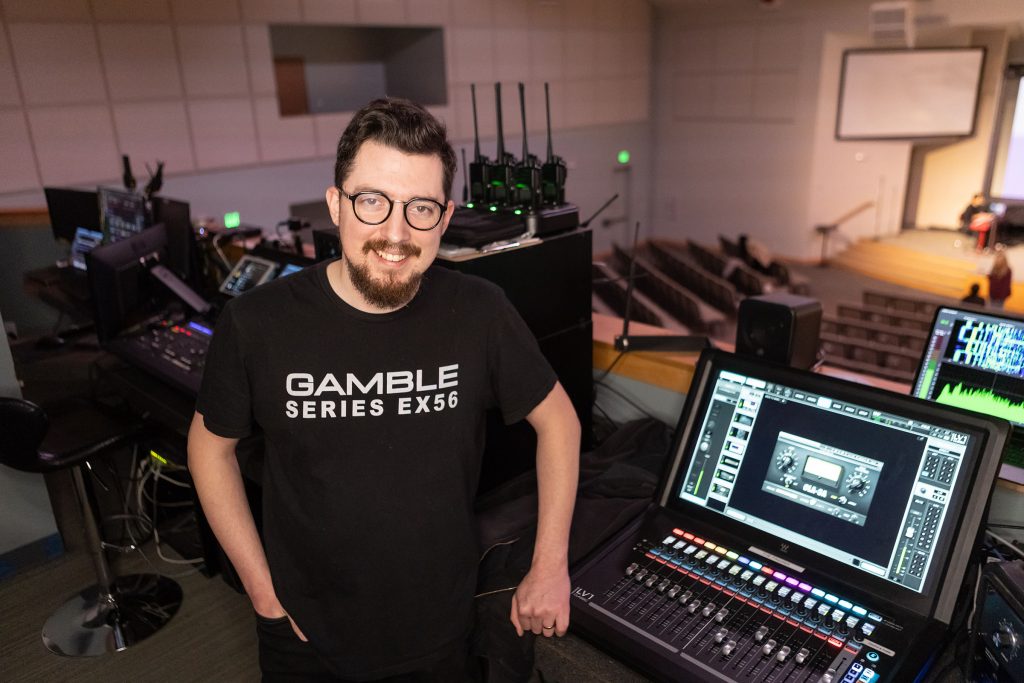
Production manager and FOH engineer Keefe Bieggar chooses the Waves eMotion LV1 Classic for The Finding Church in Bellevue, WA. Photo credit: Jason Ege.
Production manager and FOH engineer Keefe Bieggar relies on the Waves eMotion LV1 Classic console and eMo IEM immersive in-ear mixing software to manage FOH operations for The Finding Church in Bellevue, WA. The church hosts weekly services and events, requiring consistent, intelligible sound for both volunteers and visiting engineers.“Our ministry conducts weekly Sunday night services, Tuesday Bible studies, Thursday prayer sets and annual conferences,” Bieggar says. “The LV1 Classic is a perfect choice. It’s easy to use my existing Waves plugins and studio workflows in service. I’m not limited to one or two EQ options; I have the whole library of Waves plugins, unlocking limitless creative possibilities.”
Bieggar explains, “The venue is leased, while we bring in and manage all of our own gear. Our system relies heavily on Dante® infrastructure, and we are using Hear Technologies Bridge for Dante, serving as a SoundGrid to Dante bridge. All wireless mic feeds and in-ear feeds are supported via Dante, along with the backline in-ear system. Vocalists using wireless packs control their in-ear mixes via the Waves eMo IEM app. Integrating with other systems such as video, streaming or recording is seamless. The LV1 Classic has 16 I/O slots, each supporting 128×128 channels. Need more Dante? Just add another box. There are also MADI BNC and MADI Optical SoundGrid devices. The free SoundGrid driver lets us send channels to broadcast audio and our multi-track recording computer.”
Bieggar relies on custom layouts for transitions between spoken word, music and video playback: “I build layouts so important channels are always on the same faders. To maintain consistent sound quality across services, I use Scenes, but I avoid presets and templates. I reset EQs and comps, starting from zero, especially on vocals. Placement, key and mic technique all matter. What worked last week may not work the next.”
He emphasizes, “The LV1 Classic’s small footprint is a major advantage: It can fit in my car! I can’t think of another 80-channel desk I could lift on my own. Space is limited, and the Classic fits perfectly in our small venue. Patching is easy and intuitive, and custom layouts are simple to build. Plus, volunteers find it much more intuitive than traditional consoles with outboard plugins.”
“Waves plugins ensure clarity in reverberant spaces,” Bieggar notes. “I use expanders and soft gates on almost all singing and speech mics. The expander on SSL EV2 is incredible. In high-SPL worship environments or when dealing with temperamental headsets, every tool matters. Console-integrated Waves plugins provide the necessary tools that polish sources and eliminate feedback, like Waves X-FDBK and Feedback Hunter, plus great gates and expanders like Primary Source Expander (PSE) and the SSL EV2 Channel dynamics section. For reverbs, I use long plates with minimal reflection, mixing delays into those plates. I prefer to mix with effect sends rather than returns, allowing me to throw certain words or moments as they happen. On the LV1 Classic, I simply map an FX aux to a fader input and start mixing with sends. On other consoles, configuring sends and returns can be tricky. I’ve spent hours on other consoles’ offline editors configuring insert sends and returns for plugin racks. With this console, you just add a plugin. Latency compensation is handled automatically.”
Bieggar’s essential Waves plugins include the F6 Floating-Band Dynamic EQ-RTA for EQ, VEQ-4 for tonal sweetening, SSL EV2 Channel and SSL E-Channel for gating and expansion, CLA-76 and CLA-3A
He continues, “Worship leaders appreciate the Waves eMo IEM app for its control, and the immersive panning is especially popular with vocalists,” he adds. “The frontline vocalists and select instrumentalists use the personal monitoring app (MyMon app) to control their in-ear mix. The band members who use it love having granular control over every channel, and they’re big fans of the Immersive 360-degree mixing option. As an engineer, I also like that I can mask or hide channels the band doesn’t need, so when they open the app, they see only what’s relevant to them. For streaming or broadcast mixes, Abbey Road TG Mastering Chain is great for mid-side EQ and widening, and L3 Multimaximizer is a great multi-band limiter for the master bus. I use Snapshots in SuperRack to automate key changes in Waves Tune, and the same workflow applies in LV1. For events with frequent handoffs and shared mics, Snapshots allow me to save and recall each performer’s EQ and channel strip.”
“Both the FOH team and congregation are impressed,” he adds. “This is the most consistent sound we’ve ever achieved. The same plugins and chains I use in the studio are the ones I use live. I never feel like I’m fighting the console; it simply does what I need. The LV1 Classic has transformed our worship experience. Before, we had to rely on whatever desk the venue provided. Now, our own desk includes everything we need, built-in. We deliver consistent sound each week with fewer distractions.”
Bieggar concludes, “Pound for pound and spec for spec, it matches consoles that cost 4 to 10 times more. If you’re in the market for a mid-to-large-format console and plan on using Waves, why not choose one with Waves plugins built in? All channels and auxes are mono or stereo, so 64 or 80 means you could connect 160 sources and mix them to 32 stereo in-ears. You can do group-to-group and group-to-aux routing like a DAW, something most high-end consoles can’t do. You’re not limited to two or three I/O cards; you can add up to sixteen. The eMotion LV1 Classic fits a critical niche for so many churches: an affordable, high-channel-count desk that scales as the church grows.”